
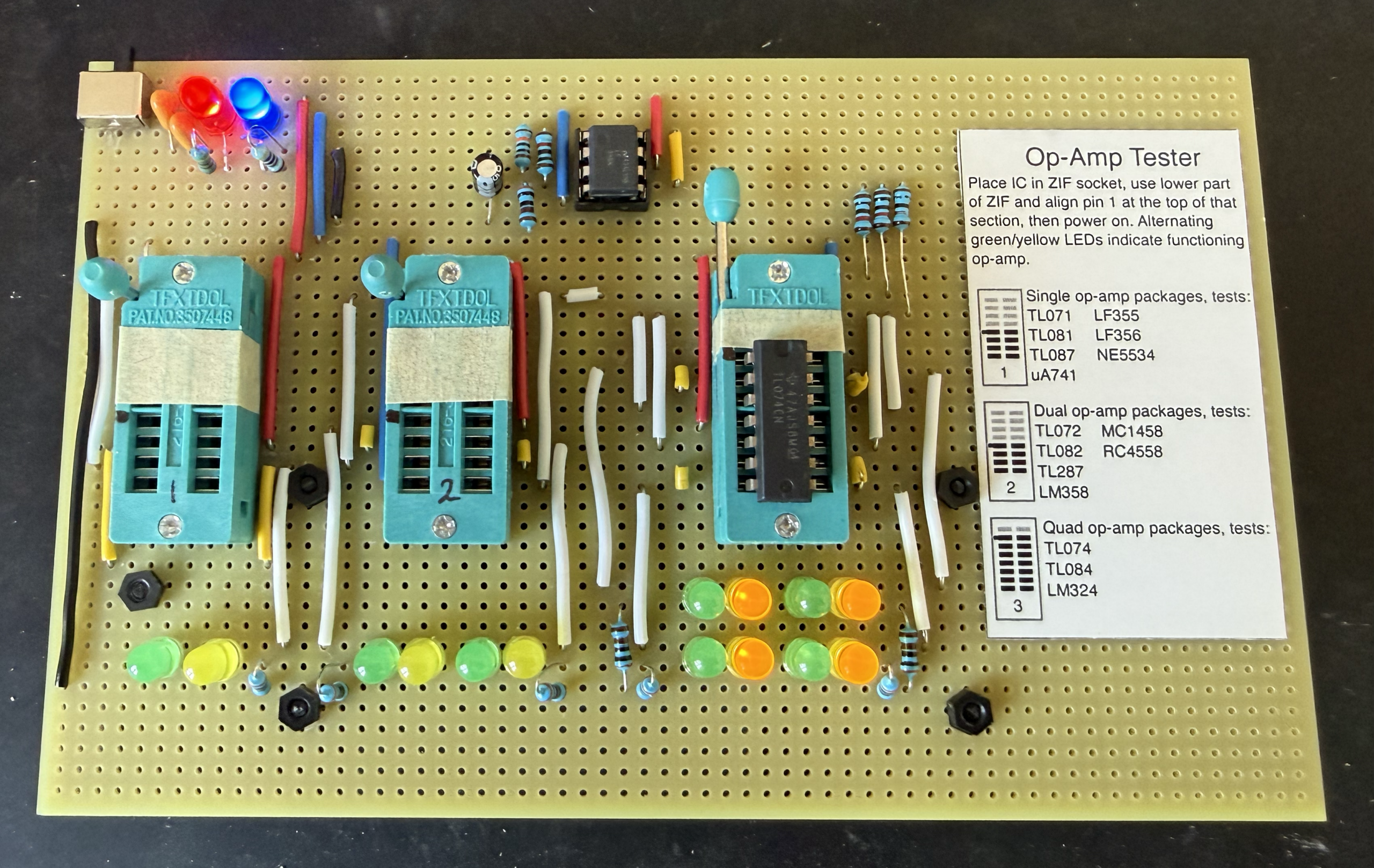
I’m part way through my next main project (building a dual VCA with curve control) and I’ve hit some issues. One of which made me think perhaps my op-amp was not doing what it should, but how to tell? So I did a bit of digging and found a design by Dirk Schumacher that was published in an old Elektor magazine (2005, vol 3). So I decided to build one to help see if this was an issue. At my level of skill it would not be the first time I fried a TL074 and then tried to figure out why things were just not working, now I can rule that out quickly 🙂
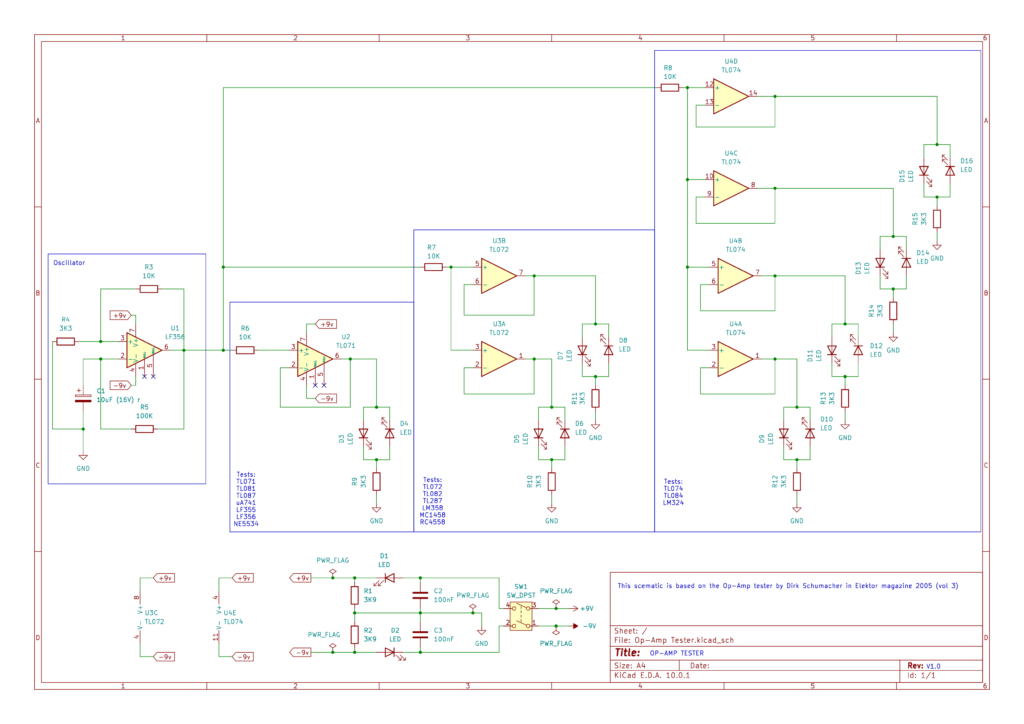
I ended up redrawing the circuit in KiKad so I could get a better understanding of it and in the process fixed an issue where the +/-9 supplies to the quad package were swapped. I’m using two 9V batteries that are not indicated on this but this drives the +/-9V power supply.
The design kicks off with the LM356 functioning as a relatively slow square wave oscillator, it’s this that’s generating the test signal being used. Then for each of the types of package that this can test (single, dual and quad) this feeds the op-amps set up as simple buffers. The output of these buffers then goes through a couple of LEDs (one for +’ve and one for -‘ve) to show the op amp is working.
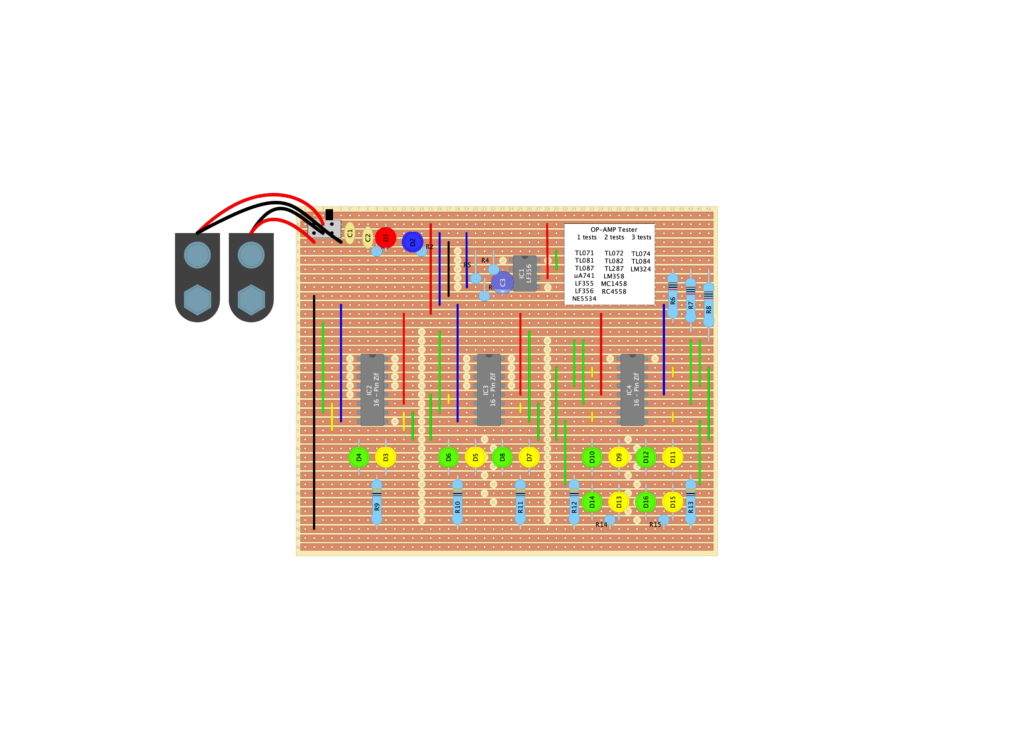
As I had a sheet of veroboard handy I decided to build this on the board so I used DIY Layout Creator to design this rather than try and force KiCad to do this for me. I left a lot of space around the IC packages as in the implementation I used some ZIF sockets I got for this. I also got some 9v battery clips in plastic cases that I was able to mount on the back of the finished board. Overall it was a pretty straight forward build, although I was using 16pin ZIF sockets which led to me having to redo all of the wiring to the quad tester because I can’t count!!!
So here it is in action! It did answer the question I had about the VCA I’m working on (the TL074 is fine) so more to do on that one.
If you think that one of these would be useful to you I put all of this documentation on my Github here, enjoy!
Leave a Reply